

Kitchen hood testing verifies that a commercial restaurant’s exhaust hood, makeup air (MUA) unit, and fire-suppression linkage operate to UL 710, NFPA 96, and the International Mechanical Code. Kitchen hood testing is required at closeout on new construction, after any hood replacement or duct re-routing, and on an annual cycle by most AHJs. We perform kitchen hood testing as a discrete TAB scope for restaurants, hotels, schools, hospitals, and any building with a Type I or Type II commercial cooking hood.
What our kitchen hood testing measures
First, our crew measures the exhaust CFM at each hood, the capture velocity at the cooking surface, the static pressure across the hood and ductwork, and the makeup air delivery from the MUA unit. Specifically, kitchen hood testing under UL 710 requires that capture and containment of grease-laden vapors meet a defined performance standard. Furthermore, NFPA 96 requires documented airflow at every Type I hood serving solid-fuel or grease-producing appliances. Therefore, the test sheet records every measured value next to the design value and the code-required minimum.
Why makeup air balance drives kitchen hood testing results
Then makeup air (MUA) balance becomes the limiting factor on most retrofit projects. Specifically, MUA should be sized to deliver 80-90% of the exhaust CFM through a dedicated unit — usually a direct-fired or indirect-fired heater with cooled supply in summer. Additionally, when MUA falls short, the kitchen pulls makeup air from the dining room or HVAC return path, which collapses comfort in the dining space and breaks the building’s pressure relationship. Therefore, kitchen hood testing always pairs exhaust verification with MUA verification — never one alone.
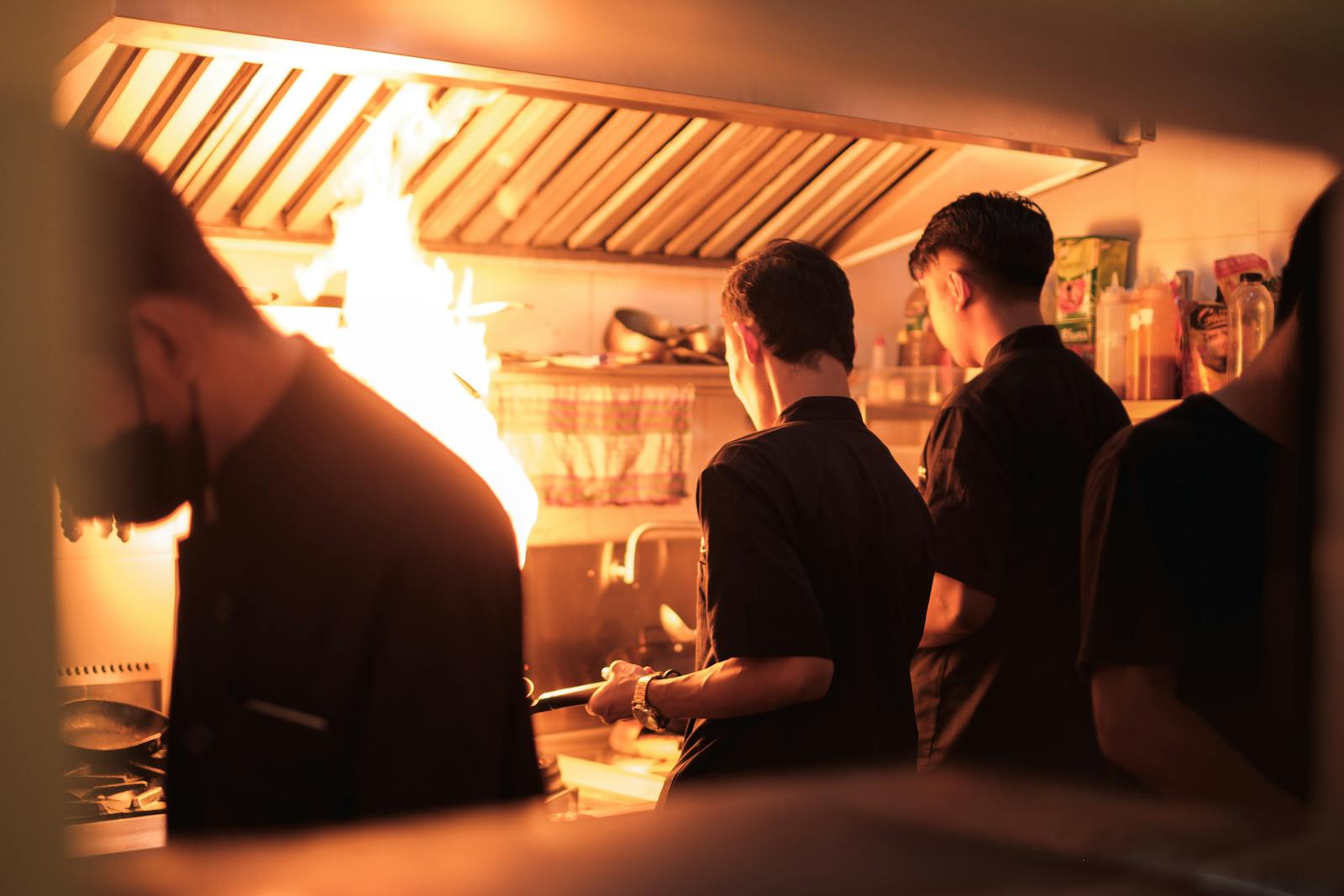
When kitchen hood testing is required
Specifically, kitchen hood testing is required at four key points in a commercial kitchen’s life. First, at new construction closeout for the certificate of occupancy. Second, after any hood replacement, MUA replacement, or duct re-routing. Third, on the annual NFPA 96 inspection cycle. Fourth, whenever a tenant complaint, code violation, or insurance audit demands it. Furthermore, hotel, school, hospital, and senior-living kitchens often layer additional certifying-body requirements (Joint Commission, AHCA, state DOH) on top of the base AHJ schedule.
What our kitchen hood testing report delivers
Furthermore, the kitchen hood testing report opens with the project metadata — restaurant name, AHJ, GC, mechanical contractor, hood manufacturer and model — and proceeds through measured exhaust CFM, capture velocity, static pressure, MUA CFM, and balance ratio for every hood on the system. Additionally, the report identifies any deficient hood with the root cause and corrective recommendation. Therefore, the document closes out the mechanical scope, satisfies the NFPA 96 annual cycle, and gives operations a tuned-system baseline that protects the building’s pressure relationship.
Industry standards on commercial kitchen ventilation
UL 710 is the principal performance standard for Type I exhaust hoods serving grease-producing appliances. NFPA 96 covers ventilation control and fire protection of commercial cooking operations, including duct cleaning frequency and fire-suppression linkage. The International Mechanical Code (IMC) Chapter 5 governs commercial kitchen ventilation system design and operation. ASHRAE Applications Chapter 34 covers commercial kitchen ventilation engineering practice. Each AHJ enforces a combination of these — Georgia generally adopts the IMC with state amendments. Restaurant tenants, hotel kitchens, school cafeterias, and hospital food-service spaces all fall under the same code framework with vertical-specific additions.
Frequently asked questions
Is annual kitchen hood testing required by code?
In most jurisdictions, yes. NFPA 96 establishes the annual inspection and testing cycle that most AHJs enforce. Our recurring-PM program puts kitchen hood testing on a calendar so it never lapses.
How long does kitchen hood testing take on a typical restaurant?
A standard single-hood restaurant typically takes 2-3 hours of field time plus 3-5 business days for the stamped report. Multi-hood operations and hotel kitchens scale linearly.
Do you test kitchen hoods after-hours so cooking isn’t interrupted?
Yes. Most kitchen hood testing on occupied restaurants runs after close — typically late evening or early morning. Our crews work the schedule that fits the kitchen’s operation.
Talk to us about a kitchen hood testing scope
Send the kitchen layout, the hood schedule, and the MUA unit specifications. You will hear back within one business day with a fixed-price proposal.